Australia Furniture Showrooms: Indoor–Outdoor Living Display Guide
Learn how Australian furniture showrooms connect indoor living rooms with outdoor-inspired spaces using coordinated furniture, static prop TV displays and practical environmental checks.

Australian furniture showrooms have a unique opportunity to demonstrate how indoor comfort and outdoor living can work together.
From contemporary apartments with balconies to spacious homes with adjoining patios, indoor–outdoor living is an important design concept for many Australian residential environments.
For furniture retailers, property developers and interior designers, the goal is not simply to place outdoor furniture beside an indoor sofa.
It is to create a convincing lifestyle setting that communicates how the two areas relate to each other.
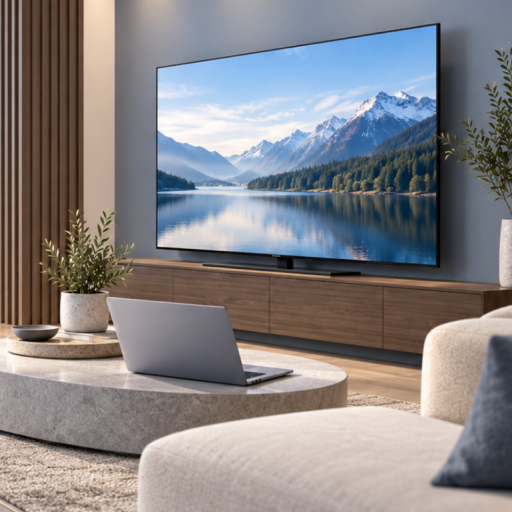
A carefully selected non-functional Prop TV can help complete the indoor living-room composition, while coordinated furniture, materials and accessories create a visual connection to an adjacent outdoor-inspired display.
However, realistic appearance and environmental suitability are different considerations.
This guide explains how to plan indoor–outdoor furniture showroom settings, select appropriate display props and identify where indoor-only television models should—and should not—be used.
1. What Is Indoor–Outdoor Living in Furniture Showroom Design?
Indoor–outdoor living refers to the relationship between interior rooms and external spaces such as patios, balconies, terraces, and gardens.
In furniture showroom design, the concept can be communicated through a carefully planned arrangement of connected display areas.
For example, a showroom might feature:
- An indoor living room with a sofa, coffee table and media cabinet
- Large-format glazing or an architectural opening
- An adjacent patio-inspired setting with outdoor seating
- Coordinated flooring, colours and natural materials
- Lighting and accessories that connect the two areas
Visitors should be able to understand how the indoor and outdoor furniture collections might work together in a residential setting.
The display does not have to reproduce a complete house.
Even within a single indoor showroom, furniture placement, architectural elements, and visual styling can suggest the relationship between a living room and an outdoor entertaining area.
The most important principle is continuity.
The two areas should feel connected without losing their individual purposes.
2. Divide the Display into Clear Indoor and Outdoor Zones
A convincing indoor–outdoor arrangement begins with defining the function of each zone.
Zone A: Indoor Living Room
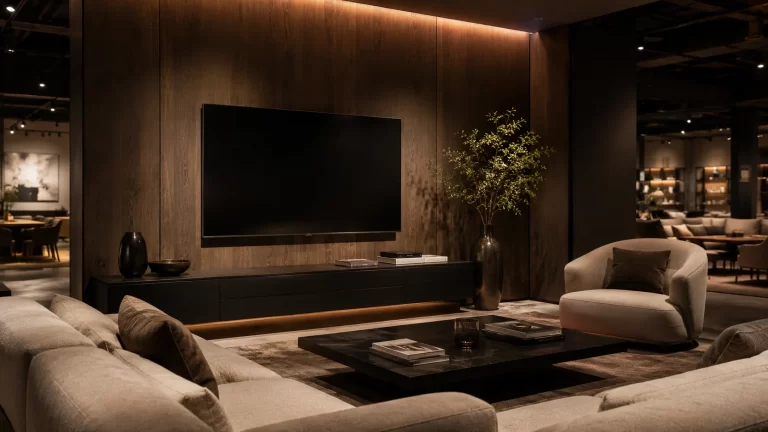
This is where a non-functional Prop TV may be appropriate.
Combine a sofa group, entertainment unit, rug, coffee table and selected accessories to create a recognisable living-room setting.
The Prop TV helps define the media wall and supports the surrounding furniture.
Its role is visual rather than electronic.
YIJIA Prop TVs use static screen artwork. They do not play videos, display changing content, or run smart-home applications.
Zone B: The Transition Area
The transition between the indoor room and outdoor-inspired setting should remain visually open.
Sliding-door frames, display partitions, changes in flooring or coordinated material finishes can establish the relationship between the areas.
Avoid adding unnecessary accessories that obstruct the customer’s view between the two settings.
The objective is to communicate openness and connection.
Zone C: Patio or Outdoor-Inspired Furniture Setting
Use outdoor seating, dining furniture, planters, rugs intended for the setting, and suitable decorative elements.
Where this zone is genuinely exposed to the weather, every product must be selected according to its actual environmental suitability.
A standard indoor Prop TV should not be assumed suitable for this area.
If the display requires a screen outdoors, choose equipment specifically rated and approved for the intended exposure and installation conditions.
A non-functional indoor prop is not automatically an outdoor display simply because it does not require electricity.
3. Select the Right Prop TV for the Indoor Living Area
Screen size affects the balance between the furniture, wall, and adjoining outdoor-inspired space.
In an open-plan showroom, the television may be visible from several angles.
It should complement the entertainment furniture without disrupting the visual relationship between the indoor and outdoor zones.
For an initial shortlist, consider:
| Indoor Room Setting | TV Sizes to Consider | Design Objective |
|---|---|---|
| Compact apartment living area | 43–50 inches | Support smaller media furniture |
| Standard open-plan living room | 55–65 inches | Complete a balanced family living area |
| Spacious indoor living zone | 70–75 inches | Work with wider media units |
| Premium feature-wall display | 85–98 inches | Support expansive interior furniture arrangements |
These ranges are visual planning suggestions, not fixed installation rules.
For example, a 65-inch Prop TV may create an appropriate visual anchor for a contemporary living-room setting that opens towards a staged patio.
However, the final size should be selected using the actual cabinet width, available wall space and customer viewing positions.
Our Prop TV Size Guide provides approximate screen proportions for comparing different models.
Before ordering, confirm the selected product’s complete external dimensions, weight and approved wall-mounted or tabletop configuration.
The intended display environment must also be suitable for the model.
4. Use Colour, Materials and Static Artwork to Connect the Spaces
An indoor–outdoor furniture display needs a coherent visual language.
The connection between the spaces can be reinforced through repeated materials and complementary colours.
Coordinate Furniture Materials
Timber tones, textured upholstery, stone-inspired finishes and restrained neutral colours can help create continuity.
For example, an indoor entertainment unit might share a similar visual character with an adjacent outdoor dining collection.
The objective is not to make indoor and outdoor furniture identical.
It is to make the entire display feel intentionally designed.
Choose Suitable Screen Artwork
A non-functional Prop TV can use a static visual image that supports the surrounding interior concept.
Possible directions include:
- Coastal landscape photography
- Nature-inspired artwork
- Restrained architectural imagery
- Minimalist abstract compositions
- Subtle colours coordinated with the furniture finishes
The artwork should belong to the indoor room’s design palette.
It should not dominate the furniture display or imply that the prop can play outdoor videos.
Depending on the selected model, custom static artwork can be discussed as part of the project specification.
Evaluate Reflections
Large windows and bright showroom lighting can affect how the screen surface appears.
Where available, a matte or reduced-reflection presentation may help manage certain reflections.
However, no ordinary finish should be assumed to eliminate glare.
Review the chosen model under the intended lighting conditions and from the customer’s main viewing positions.
5. Three Australian Showroom Design Concepts
The following are illustrative design concepts, not descriptions of completed YIJIA customer projects.
Sydney: Coastal-Inspired Apartment Living
Imagine an indoor furniture display with a light-coloured sofa, timber media cabinet and a carefully styled coffee table.
A 55-inch or 65-inch non-functional Prop TV with restrained coastal artwork completes the interior entertainment setting.
Beside it, a balcony-inspired furniture arrangement uses compact outdoor chairs, a small table and complementary accessories.
The indoor Prop TV remains within the protected interior setting.
The balcony concept is communicated through furniture, finishes and architectural styling rather than placing an indoor electronic prop in an exposed environment.
Melbourne: Contemporary Open-Plan Living
Consider a showroom presenting a modular sofa collection, dark entertainment unit and architectural feature wall.
An appropriately sized Prop TV establishes the living-room function.
An adjoining dining or terrace-inspired furniture display can be connected through coordinated flooring and visual sightlines.
This arrangement allows customers to consider how different furniture collections might work together in a modern open-plan home.
The complete display should be evaluated from the showroom entrance and main customer walkway.
Brisbane: Indoor Living Connected to a Patio Concept
Imagine a furniture display featuring a relaxed sofa arrangement, natural textures and an adjoining covered-patio-inspired space.
The living room may use a non-functional television model as a familiar visual reference.
Outdoor-inspired furniture and planting elements establish the second zone.
The installation must distinguish between a fully controlled interior showroom and a genuinely open or weather-exposed patio.
A roof alone does not automatically make a space suitable for an indoor display prop. Wind-driven rain, humidity, dust, and other environmental conditions may still affect the product.
For broader Australian showroom planning ideas, explore our Australian furniture showroom Prop TV guide.
6. Where Should a Prop TV Be Placed—and Where Should It Not?
This is one of the most important questions when specifying display props for indoor–outdoor concepts.
Suitable Situations to Consider
A non-functional Prop TV may be appropriate in a controlled indoor furniture showroom, furnished apartment display, or protected interior model-home setting.
Its suitability still depends on the selected model, installation method and actual room conditions.
Situations That Require Additional Approval
A display may be close to large open doors, a frequently exposed entrance, an enclosed sunroom or a semi-open commercial space.
Before using a Prop TV in these locations, confirm whether environmental exposure is compatible with the manufacturer’s specified limits.
Consider moisture, condensation, direct sunlight, temperature variation, dust, wind and the possibility of customer contact.
Situations Where an Indoor Prop Should Not Be Assumed Suitable
Do not specify a standard indoor Prop TV for an uncovered patio, exposed balcony, garden or other weather-exposed area without documented confirmation that the exact product is designed for those conditions.
The absence of electrical components does not demonstrate resistance to water, UV exposure, wind or temperature extremes.
If a genuine outdoor television display is required, use equipment specifically designed and appropriately rated for the location.
If the outdoor area only needs lifestyle staging, furniture and suitable outdoor accessories may communicate the concept without any television.
7. Design for Customer Sightlines and Photography
An indoor–outdoor showroom concept should be understood from more than one position.
A display may look balanced from the front but become visually confusing from the main aisle.
Before approval, assess three viewpoints.
Showroom Entrance
Can customers understand the relationship between the indoor living room and the outdoor-inspired furniture area?
Main Customer Walkway
Does the Prop TV support the indoor furniture setting without obstructing the view towards the adjacent zone?
Photography Position
Can the photographer capture both furniture settings in a cohesive composition without unwanted screen reflections or distracting accessories?
Static screen artwork can simplify visual consistency during photography because it does not change electronically.
However, reflections, visible edges, product placement, and lighting still require review.
For ideas about coordinating Prop TVs with complete room settings, explore our furniture showroom project gallery.
8. Prepare an Indoor–Outdoor Showroom Display Specification
For a professional furniture retailer or interior design project, a documented display specification helps different teams work from the same plan.
The specification should clearly distinguish the indoor TV display from any outdoor furniture installation.
| Project Element | Details to Record |
|---|---|
| Indoor room type | Living room, apartment or premium media wall |
| Outdoor-inspired zone | Patio, terrace, balcony or garden concept |
| Actual environment | Controlled indoor, semi-open or weather-exposed |
| Prop TV model | Approved size and product reference |
| Screen artwork | Static image and finish |
| Installation | Wall-mounted or tabletop requirements |
| Room dimensions | Media cabinet, wall and circulation space |
| Safety review | Physical support and environmental suitability |
| Quantities | Units per room setting or store |
| Delivery | Australian destination postcode and required date |
The environmental classification should be reviewed before ordering.
A visual concept showing a patio does not establish that every object in the drawing is suitable for actual outdoor use.
For retailers planning multiple installations, our showroom display solutions provide a framework for coordinating room types, display products and quantities.
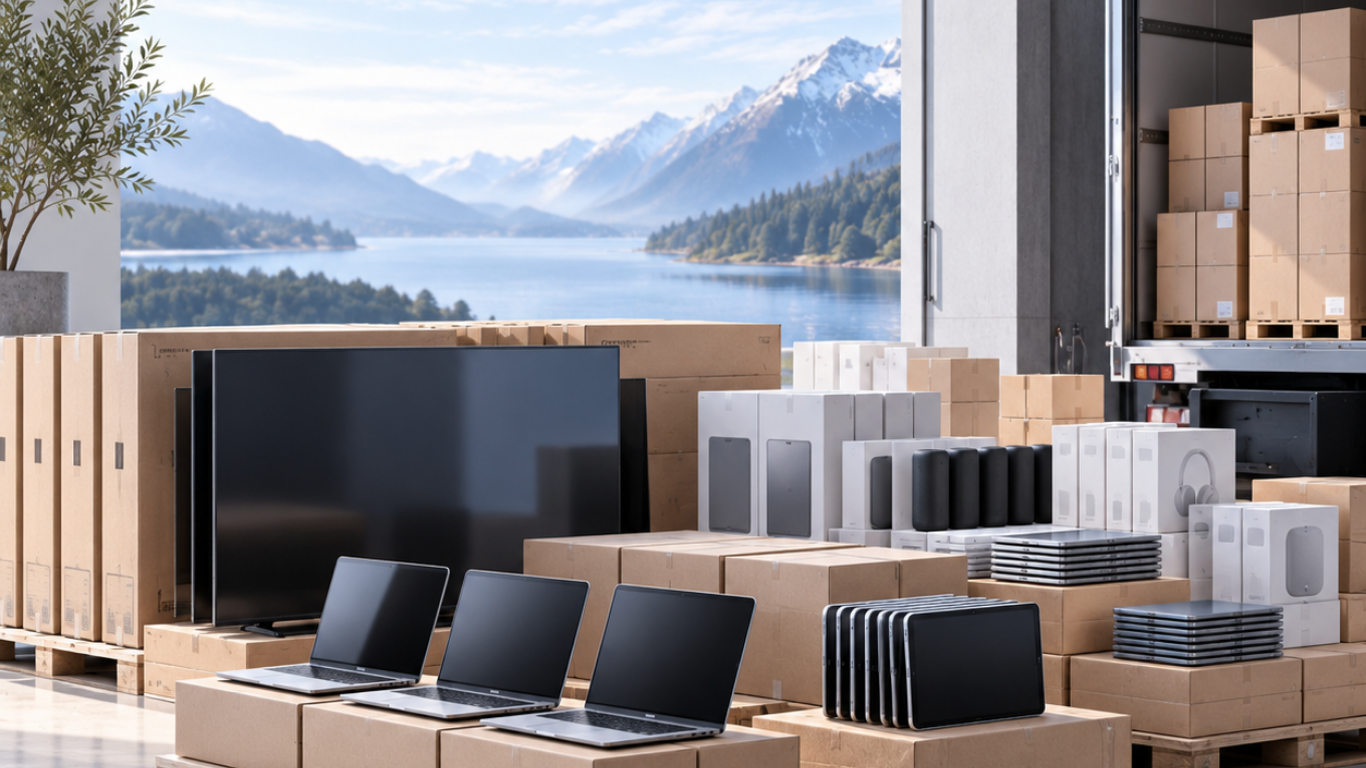
9. Plan Australian Showroom Procurement and Delivery
Once the design concept has been approved, the purchasing team should prepare a product schedule.
For Australian destinations, provide the city, postcode and receiving arrangements.
A central warehouse delivery may suit a retailer coordinating several stores, while a smaller project may require delivery to a single showroom or property location.
For each proposed Prop TV, confirm:
- Model size and quantity
- Frame appearance and static artwork
- Actual product dimensions and weight
- Wall-mounted or tabletop configuration
- Intended indoor environmental conditions
- Required accessories and packing
- Delivery destination
- Target arrival and installation dates
- Sample approval requirements
If the project involves importation, clarify freight arrangements, customs responsibilities, applicable taxes, and agreed delivery terms in the formal quotation.
For mixed-size or multi-store orders, include a location-by-location quantity schedule.
The supplier should confirm actual product availability and shipping arrangements rather than assume that every model can be supplied under the same terms.
10. Final Indoor–Outdoor Furniture Display Checklist
Before approving the complete showroom, review the following questions.
Design
- Does the indoor furniture setting have a clear purpose?
- Is the outdoor-inspired zone visually connected?
- Are furniture proportions and materials coordinated?
- Does the Prop TV support the living-room composition?
Product Suitability
- Is the Prop TV installed in a suitable environment?
- Have moisture, sunlight, wind, and other exposure risks been assessed?
- Are the actual model dimensions confirmed?
- Are the support structure and mounting method appropriate?
Presentation
- Is the static screen artwork approved?
- Have reflections been reviewed?
- Does the display look balanced from the main customer approach?
- Are photography viewpoints suitable?
Procurement
- Are the approved models and quantities recorded?
- Is a sample review needed?
- Are packing and handling arrangements confirmed?
- Are Australian delivery details and project dates available?
A completed checklist helps connect the showroom design concept with practical product selection and supply planning.
Frequently Asked Questions
Can YIJIA Prop TVs be used outdoors?
Do not assume so. Standard non-functional indoor Prop TVs should not be treated as weatherproof products. Outdoor or semi-exposed suitability must be confirmed for the exact model and conditions before use.
Does a Prop TV need electricity?
No. YIJIA Prop TVs are non-functional visual display models. They do not require electricity for video playback because they cannot play videos or run electronic applications.
Can a dummy TV display ocean waves or outdoor scenes?
It can present suitable static artwork, such as a coastal photograph, depending on the selected model and available image options. It cannot play moving ocean footage or streaming video.
What size Prop TV works best in an open-plan Australian living room?
That depends on the media cabinet, wall dimensions and furniture arrangement. Sizes from 55 to 65 inches can be considered for many standard living-room concepts, while larger displays may suit more spacious settings.
Is a covered patio safe for an indoor Prop TV?
Not necessarily. A covered patio may still experience wind-driven rain, humidity, direct sunlight, dust, and temperature changes. Confirm product suitability rather than assuming that overhead cover provides adequate protection.
Can Prop TVs be used in indoor furniture showrooms that display outdoor furniture?
Yes, provided the Prop TV is positioned in an environmentally suitable indoor area and supports the intended room concept. Outdoor furniture can be displayed nearby without exposing the indoor prop to outdoor conditions.
Can Australian furniture groups order several Prop TV sizes?
Mixed-size requirements can be discussed based on model availability, quantities, artwork, installation configurations and delivery arrangements.
What information should be included in an Australian project enquiry?
Provide room photographs, the intended indoor–outdoor layout, environmental conditions, preferred TV sizes, quantities, installation method, delivery postcode and target project date.
Plan Your Australian Indoor–Outdoor Furniture Display with YIJIA Props
An effective indoor–outdoor furniture showroom communicates how different spaces can support one connected lifestyle.
The visual relationship between the sofa, media cabinet, dining furniture, patio setting, lighting and materials is more important than any individual accessory.
A non-functional Prop TV can complete the indoor living room while maintaining a controlled static visual presentation.
The key is to select the right size, artwork and installation method—and to respect the environmental limits of the actual product.
YIJIA Props supplies non-functional display televisions for furniture showrooms, model homes, interior staging and professional display projects.
Whether you are developing a single Australian furniture showroom concept or coordinating several retail locations, we can review appropriate indoor display models and project supply requirements.
Explore our professional Prop TV collection to compare available sizes.
Request an Australian indoor–outdoor showroom quote with your room layout, preferred TV models, quantities, installation requirements, intended environmental conditions and delivery destination.
A clear project brief helps turn the design concept into a practical and appropriately specified display plan.